
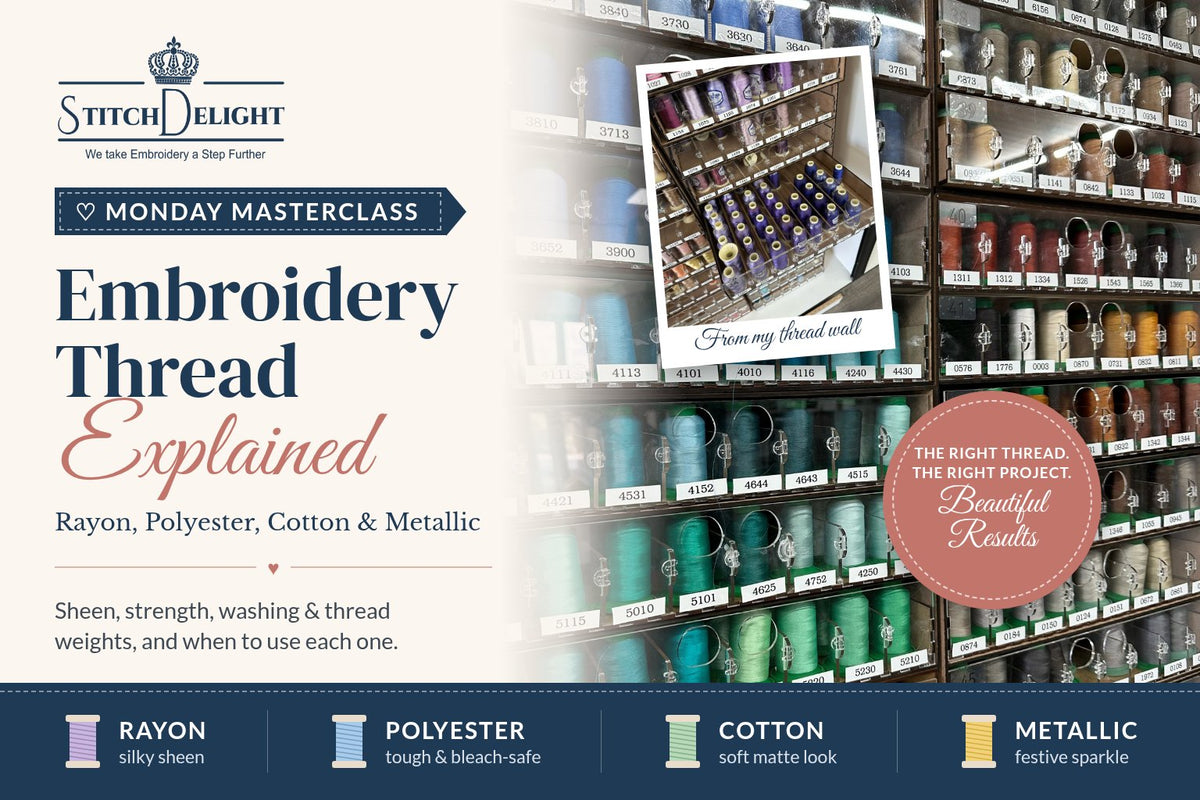
Choosing the Right Thread for Every Project

From the Stitch Delight thread wall
Walk into any embroidery shop and the thread wall is pure eye candy. Hundreds of colours, shiny spools, matte spools, sparkly spools... and labels that say rayon, polyester, cotton, metallic, 40 wt, 60 wt.
It's no wonder so many of us simply grab the prettiest colour and hope for the best!
Over the past few months we've talked about bobbin thread, tension and thread breaks. I promised you a Masterclass dedicated entirely to embroidery thread, so this week we're finally getting to know the top thread properly.
Because here's the thing: the thread is the part of your embroidery everyone actually sees.
Difficulty: ⭐☆☆☆☆ Beginner
You'll Learn:
- ✔ The real differences between rayon, polyester, cotton and metallic thread
- ✔ Which threads survive bleach and hot washes, and which don't
- ✔ What thread weights mean (40 wt vs 60 wt and friends)
- ✔ How to choose the right thread for each project
- ✔ How to store thread so it lasts
- ✔ How to stitch with metallic thread without tears (yours or the thread's!)
Why Thread Choice Matters
Thread isn't just colour on a spool. Every fibre has its own personality.
Some threads shine like silk. Some are tough enough to survive a hundred hot washes. Some give a soft, vintage look that's perfect on a quilt. And some add a sparkle nothing else can match.
Think of thread like paint. Gloss, satin, matte and metallic paint can all be the same colour, yet each one creates a completely different finish, and each one is suited to a different room in the house.
Choosing the right thread for the job is one of those small decisions that makes a big difference to the finished project.
Rayon: The Queen of Sheen
Rayon (often sold as viscose) is made from regenerated cellulose, usually wood pulp. It has been a favourite of home embroiderers for decades, and for good reason.
Rayon has a beautiful, soft, silky lustre that catches the light wonderfully. Satin stitches in rayon almost glow, and the thread feels soft against the skin.
It also runs smoothly through most machines and is lovely to stitch with.
But rayon does have a delicate side:
- • It is not as strong as polyester, especially when wet
- • It does not like chlorine bleach, which can strip the colour
- • Very hot washes and harsh detergents can fade it over time
Best for: wall hangings, décor pieces, gifts, heirloom projects and anything that will be washed gently or not at all.

From the Stitch Delight thread wall
Polyester: The Tough All-Rounder
Many years ago polyester embroidery thread had a reputation for looking dull and plastic-like. Not anymore!
Modern embroidery polyester (often called trilobal polyester, because each filament has a three-sided shape that reflects light) has a sheen that comes very close to rayon. Most people simply can't tell the difference on a finished design.
Where polyester really shines, though, is strength and durability:
- • It is very strong and resists breaking at higher speeds
- • It is highly colourfast
- • Most embroidery polyester is bleach resistant (always check your brand's label)
- • It handles hot washes and tumble drying with ease
This makes polyester the obvious choice for anything that will be washed often or roughly: towels, baby blankets, kids' clothing, aprons, uniforms and work wear.
Personally, polyester is my everyday thread. If I'm unsure what a project will face once it leaves my sewing room, polyester is the safe bet.
💡 Tip: Planning to give an embroidered towel or baby bib as a gift? Use polyester. You never know whose washing machine (or bleach!) it will end up in.
Cotton: The Natural Beauty
Cotton thread brings something different to the table: a soft, matte finish with very little shine.
That makes it perfect when you want embroidery to look natural, old-fashioned or hand-stitched rather than glossy. Redwork, vintage motifs and embroidery on linen look especially lovely in cotton.
For those of us who love quilting, cotton thread also sits beautifully alongside quilting cotton fabric. Both fibres age, shrink and soften together, which is why many quilters prefer cotton for all-cotton projects.
A few things to keep in mind:
- • Cotton produces more lint than polyester or rayon, so clean your bobbin area more often
- • It is not as strong as polyester
- • Chlorine bleach can fade the colour
- • Cotton embroidery thread often comes in heavier weights such as 30 wt, which changes how the design covers
Best for: quilts, in-the-hoop quilt blocks, redwork, linen and heirloom projects where you want a soft, matte look.

Metallic: A Little Sparkle Goes a Long Way
Nothing says celebration quite like metallic thread. A touch of gold on a Christmas ornament or silver on a wedding gift instantly lifts a design.
Most metallic embroidery thread is made by wrapping a thin metallic foil or film around a core thread. That construction is exactly what makes it so beautiful, and also what makes it a little temperamental.
Metallic thread is:
- • More fragile, and can fray or shred if it's pushed too hard
- • Prone to twisting and kinking as it comes off the spool
- • Sensitive to heat, so it should never meet a hot iron directly
- • Not suited to bleach or rough washing
Used thoughtfully, though, it is absolutely worth the extra care. I'll share my best metallic tips further down.
Best for: accents, outlines, highlights, festive designs and lighter-density designs.

Side by Side: How the Four Threads Compare
Here's a quick visual summary. Remember that quality varies between brands, so treat this as a general guide rather than a rule book.

| Rayon | Polyester | Cotton | Metallic | |
|---|---|---|---|---|
| Look | Soft, silky high sheen | Bright sheen, close to rayon | Soft matte | Sparkle & shimmer |
| Strength | Medium (weaker when wet) | Very strong | Medium | Delicate |
| Chlorine bleach | No | Usually yes | Not recommended | No |
| Washing | Cool to warm, gentle | Hot washes & tumble dry | Warm; may shrink slightly | Cool, gentle, inside out |
| Ironing | Medium heat | Low to medium heat | Can take higher heat | Low heat, from the back, with a pressing cloth |
| Ideal for | Décor, gifts, heirlooms | Towels, kids' wear, everyday items | Quilts, redwork, linen | Accents & festive designs |
Thread Weights: What Do the Numbers Mean?
This is the part that confuses almost everyone, so don't worry if it has puzzled you too.
Thread weight is based on how much a fixed weight of thread measures in length. The finer the thread, the more of it you get for the same weight.
That leads to the one rule worth remembering:
The higher the number, the finer the thread.
So 60 wt thread is finer than 40 wt, and 30 wt is thicker than 40 wt.

30 wt
A thicker thread that gives bold coverage with fewer stitches. Lovely for redwork, outlines and a more hand-stitched look. Usually paired with a slightly larger needle such as a 90/14.
40 wt
The standard embroidery thread weight. The vast majority of embroidery designs, including ours, are digitized with 40 wt thread in mind. When in doubt, this is your thread. It's normally paired with a 75/11 embroidery needle.
50 wt
You'll mostly see this in cotton quilting and piecing threads. It's a little finer than 40 wt.
60 wt
A fine thread that is wonderful for tiny lettering and delicate detail, and for a coloured bobbin on freestanding lace. If small text has ever disappointed you, take a look at my Masterclass on making tiny text stitch beautifully. Pair it with a smaller needle such as a 65/9 or 70/10.
90 wt
Ultra-fine thread used mainly in the bobbin, which we covered in Bobbin Thread Basics.
💡 Important: A design digitized for 40 wt thread won't automatically look the same in a different weight. Stitch a 40 wt design in 60 wt thread and you may see gaps, because the finer thread doesn't fill as much space. Stitch it in 30 wt and the design can become stiff and bulky. This all comes back to stitch density, so whenever you change thread weight, do a test stitch-out first.
One more thing: thread weight isn't perfectly standardised between brands, and some threads use other numbering systems altogether. Two "40 wt" threads from different manufacturers can feel slightly different. If a new brand suddenly behaves differently, that may be why.
For choosing the right needle size for each thread, my needles Masterclass goes into much more detail.
Which Thread When?
So how do you actually decide? I find it helps to ask myself a few simple questions about the project before I choose a thread.

And yes, you can absolutely mix threads within one design! A polyester design with a few metallic highlights is a lovely combination. Just make sure every thread in the design can handle the way the finished item will be washed.
Looking After Your Thread
Thread is an investment, and many of us have built up quite a collection over the years (I certainly have!). A little care helps it last much longer.

From the Stitch Delight thread wall
This is my own thread wall. Every cone sits in a clear acrylic rack, sorted by colour and labelled with its colour number, so I can find the exact shade a design calls for in seconds. The racks also keep dust off and stop cones from rolling around and tangling.
- ✔ Keep it out of the sun. Here in South Africa our sunshine is glorious, but UV light fades and weakens thread, especially rayon and cotton. Never store spools on a sunny windowsill.
- ✔ Keep it covered. Dust settles on thread and travels straight into your tension discs and bobbin area. A closed box, drawer or cabinet works well.
- ✔ Avoid heat and humidity. A hot garage or a damp cupboard can make thread brittle or encourage mildew. Coastal embroiderers, keep an eye out for damp.
- ✔ Sort and label. Arranging cones by colour family and labelling each spot with the colour number makes matching a design's colour chart so much quicker, and you'll immediately see when a favourite shade is running low.
- ✔ Secure loose tails. Tuck the end into the spool's notch or use a thread net so it doesn't unravel and tangle.
- ✔ Do the snap test on old thread. Pull a length firmly between your hands. If it snaps easily, retire it to hand projects. Old, brittle thread is a common cause of breaks and fraying.
Taming Metallic Thread
Metallic thread has a reputation for being difficult, but most problems come down to a few simple adjustments.
- ✔ Use a metallic or topstitch needle. These have a larger eye and a special groove that protects the delicate foil. A 90/14 is a good starting point.
- ✔ Slow down. Reducing your machine speed is the single biggest improvement you can make. Start at around half your normal speed and adjust from there.
- ✔ Let it unwind properly. Metallic thread twists when it is pulled off the side of the spool. A vertical spool pin or a separate thread stand lets it feed smoothly.
- ✔ Loosen the top tension slightly if the thread keeps shredding.
- ✔ Choose lighter designs. Very dense fills put metallic thread under a lot of stress. Outlines, running stitches and open designs are ideal.
- ✔ Replace the needle often. A slightly worn needle that rayon or polyester wouldn't notice can shred metallic thread.
💡 Pressing tip: Never iron directly on metallic embroidery. Place the embroidery face down on a fluffy towel and press from the back on a low setting, ideally with a pressing cloth.
If your metallic thread still loops or tangles underneath, my Masterclass on birdnesting will help you track down the cause.
Could My Thread Be Causing Problems?
Sometimes, yes. Thread is often overlooked when stitching goes wrong.
Old or poor-quality thread, the wrong weight for the design, or a needle that's too small for the thread can all lead to breaks, shredding, poor coverage or puckering in a dense design.
Before reaching for the tension dial, ask yourself:
- • Is this thread fresh and of good quality?
- • Is it the weight the design was digitized for?
- • Is my needle the right size and type for this thread?
- • Is the thread unwinding smoothly from the spool?
Quite often the answer is right there on the spool.
Three Rules Every Embroiderer Should Remember
Rule #1 Choose your thread for the way the item will be used and washed, not just for its colour.
Rule #2 The higher the thread weight number, the finer the thread, and changing weight changes how a design covers.
Rule #3 Metallic thread loves a larger-eyed needle, a slower speed and a lighter design.
Final Thoughts
There's no single "best" embroidery thread. Rayon brings the sheen, polyester brings the strength, cotton brings the soft natural charm and metallic brings the sparkle.
Once you understand what each thread does well, you'll start choosing thread the way you choose fabric: with the finished project in mind.
And remember, when in doubt, a good 40 wt polyester and a test stitch-out will rarely let you down.
Until then... happy stitching!
Photo credits: Wooden spools of sewing thread by W.carter, Wikimedia Commons, CC BY-SA 4.0. Metallic thread by Ryj, Wikimedia Commons, CC BY-SA 3.0. Thread wall photos and illustrations © Stitch Delight.





4 comentarios
Annette
Do you have this information in a PDF which could be saved for reference? That would be valuable information to have on file! Thanks for this information on the subject!
Janet Landry
Do you have this in a PDF File.? Would like to print it/ Thanks Sew Much. Hugs
Brenda Haas
I agree with Grace. This is a nice refresher. Thank you. Just out of curiosity, what type of storage racks are you using? They look a bit like OESD store racks.
Grace Fredrick
Thank you for the thread education. Although I was aware of some to most of the information it was a great refresher and some aha moments. I have a few friends who are just starting out in embroidery, and this article will be a great informational and educational addition to my and their files.
Once again love your designs and thank you.