
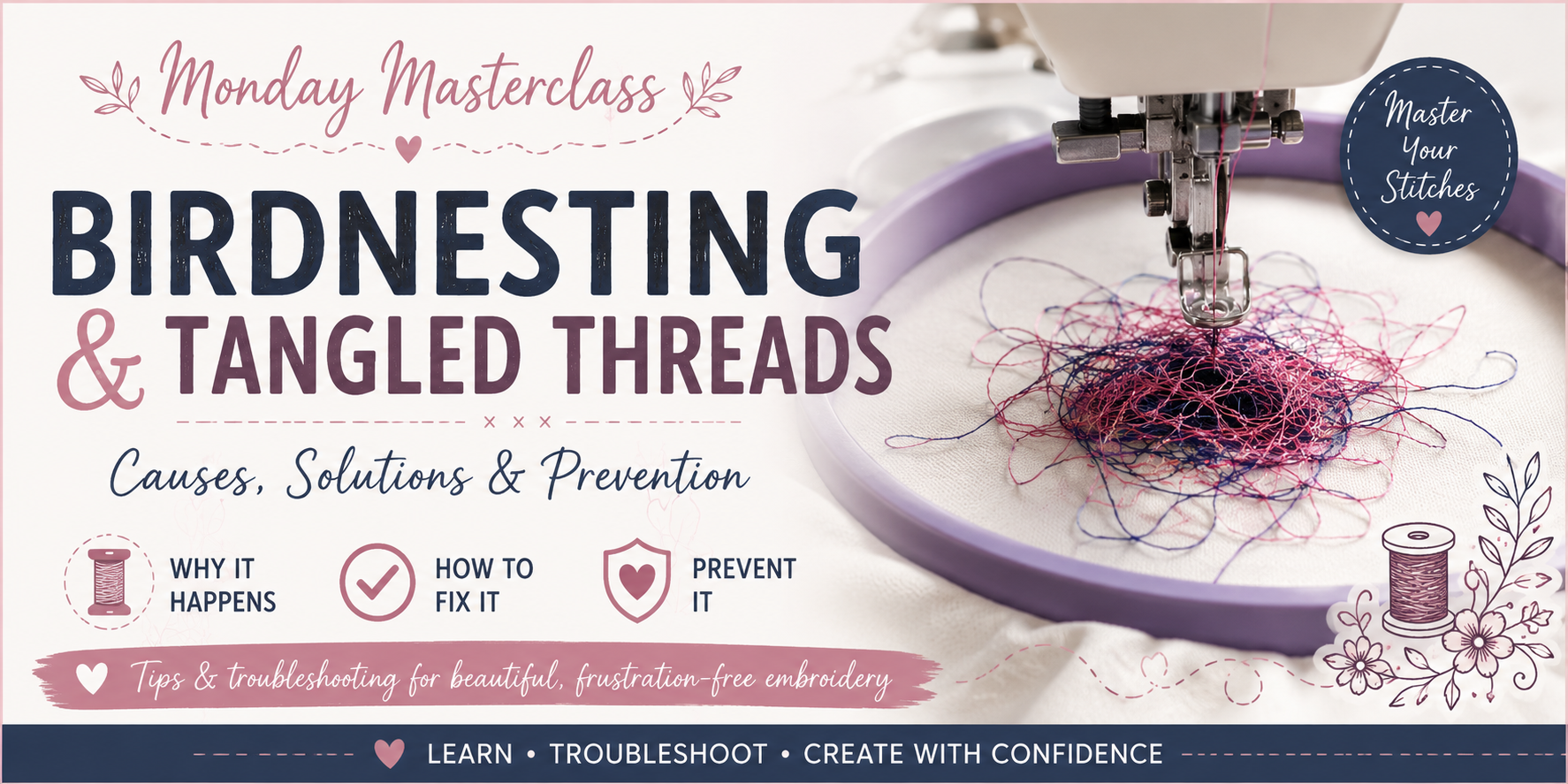
Monday Masterclass — Birdnesting & Tangled Threads
Few things frustrate embroiderers more than lifting a hoop and discovering a tangled mess of thread underneath the fabric. Whether you are a beginner or have years of embroidery experience, birdnesting can happen to anyone.
The good news is that birdnesting is usually not caused by the embroidery design itself. In most cases, it comes down to threading, tension, bobbin setup, or machine preparation — all things that can be corrected quite easily once you understand what to look for.
What Is Birdnesting?
Birdnesting refers to large loops or tangled masses of thread that collect underneath the embroidery. The underside of the design may look messy, knotted, or tightly tangled, and sometimes the machine may even jam completely.
Common symptoms include:
- Large loops underneath the fabric
- Tangled thread buildup
- Machine locking or jamming
- Broken threads
- Uneven stitching
- Fabric being pulled into the needle plate
Birdnesting often happens suddenly, especially at the beginning of a design or after a thread change.
The Most Common Causes Of Birdnesting
1. Incorrect Threading
This is by far the most common cause.
Many embroiderers accidentally thread their machine with the presser foot down. When this happens, the tension discs remain closed and the thread cannot seat properly inside the tension system.
As soon as stitching begins, the machine cannot control the top thread correctly, which leads to loops and tangles underneath.
Always remember:
✔ Thread the machine with the presser foot UP.
Also check:
- missed thread guides
- incorrect threading path
- thread catching somewhere above the machine
Even experienced embroiderers occasionally miss a guide while rushing.

2. Bobbin Problems
The bobbin area is another common source of trouble.
Birdnesting can happen when:
- the bobbin is inserted incorrectly
- the bobbin is wound unevenly
- lint has built up in the bobbin area
- the wrong bobbin type is being used
A poorly wound bobbin can create inconsistent tension and thread feeding problems.
Take a few moments to:
- remove lint regularly
- check bobbin direction
- ensure the bobbin clicks into place correctly
Small maintenance habits prevent many embroidery headaches.
3. Top Tension Issues
If the top tension is too loose, the upper thread may not be held securely during stitching. This often results in loops forming underneath the embroidery.
Before adjusting tension settings dramatically, always:
- Rethread the machine completely
- Replace the needle if necessary
- Check the bobbin area
Many tension problems are actually threading problems in disguise.
4. Needle Problems
A damaged or incorrect needle can quickly create stitching chaos.
Problems include:
- bent needles
- dull needles
- incorrect needle type for the fabric
- old needles used too long
Needles are inexpensive compared to the frustration caused by poor stitching.
As a general rule:
replace needles regularly, especially when changing fabric types or after heavy stitching sessions.
5. Loose Hooping & Fabric Movement
If fabric shifts inside the hoop, thread tension becomes inconsistent and birdnesting can occur.
Make sure:
- fabric is hooped firmly
- stabilizer is appropriate
- the hoop is tightened correctly
- fabric is not bouncing during stitching
Good hooping solves many embroidery quality issues before stitching even begins.
What To Do If Birdnesting Happens
The worst thing you can do is continue stitching while the threads tangle underneath.
Instead:
Step 1
Stop the machine immediately.
Step 2
Carefully remove the hoop.
Step 3
Cut away tangled thread underneath the fabric.
Step 4
Rethread the upper thread completely.
Step 5
Check the bobbin insertion and bobbin area.
Step 6
Replace the needle if you are unsure about its condition.
Step 7
Test stitch before continuing the design.
Trying to “push through” birdnesting usually creates even bigger problems.
Common Beginner Mistakes
Many embroidery beginners experience birdnesting because of a few simple habits:
- threading too quickly
- threading with the foot down
- using poor quality thread
- ignoring lint buildup
- not changing needles often enough
- rushing hooping preparation
The important thing to remember is:
birdnesting is part of the learning process.
Every embroiderer has dealt with it at some point.
Preventative Habits That Help
Over time, good habits dramatically reduce embroidery problems.
Try to build routines such as:
- cleaning the machine regularly
- checking threading carefully
- using quality thread
- replacing needles often
- testing designs before important projects
- slowing down when problems appear
Embroidery machines are incredibly reliable when properly prepared.
Final Thoughts
Birdnesting may feel frustrating in the moment, but it is also one of the best troubleshooting teachers in embroidery.
The more calmly and methodically you approach problems, the more confident you become with your machine.
Most importantly:
do not assume you are doing everything wrong simply because birdnesting happens occasionally.
Even experienced embroiderers encounter thread tangles from time to time.
The difference is that experience teaches you how to troubleshoot quickly, calmly, and confidently.
Happy stitching 🌸
Daleen



5 comentarios
Flo
I used to get annoyed and now I see it as a chance to learn more about the machine.Thank you for all the tips and tricks
Nora Nevers
Great information, I think the most detailed I have ever seen. Now could you do one for multi needle commercial machines?
Diva
You are the “Best” so many of us struggle with this at various times.
Information is the key to success, thank you for sharing.
Bobbie
My machine used to nest often- then I realized it was happening after every color change. I began re-seating the bobbin whenever I changed the top thread and it hasn’t been an issue.
Thank you for the great list of reminders- so often in the midst it is difficult to remember what the solution is & then you’re fighting with your machine and frustrated
Melanie Erasmus
Good day, love the Monday subject conversations. Help me to remember all check points to go through when the problem do happen. Used two already in the passed few weeks.