
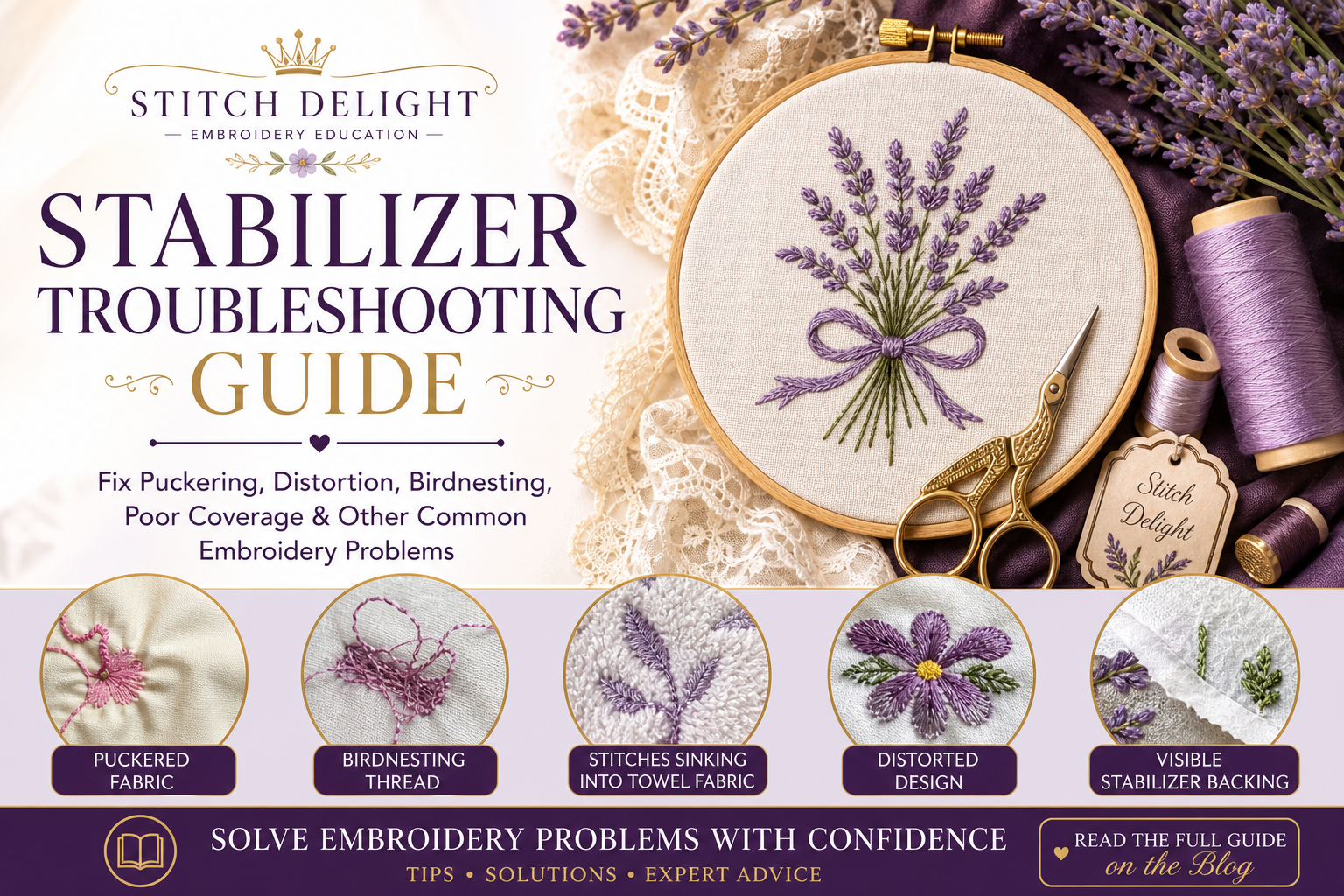
The Stabilizer Troubleshooting Guide
25 Common Embroidery Problems and How to Fix Them
One of the biggest misconceptions in embroidery is that every problem is caused by the machine, the thread, or the digitizing.
In reality, many embroidery issues can be traced back to one simple cause: inadequate or incorrect stabilization.
Before you blame your machine, change your needle, or throw away a perfectly good design, work through this troubleshooting guide.
You may discover that the solution has been hiding underneath your hoop all along.
Problem #1
Fabric Is Puckering Around The Design
What You See
The embroidery looks wrinkled and gathered, especially after removing it from the hoop.
Common Causes
-
Stabilizer too light
-
Insufficient layers of stabilizer
-
Fabric not hooped correctly
-
Dense design on lightweight fabric
Solution
-
Increase stabilizer weight
-
Use a fusible stabilizer
-
Consider floating an additional layer
-
Slow machine speed on delicate fabrics
Problem #2
Design Looks Smaller Than Intended
What You See
Circles become oval.
Squares become rectangles.
Common Causes
-
Fabric stretched during hooping
-
Insufficient stabilization
-
Knit fabric using tear-away
Solution
-
Switch to cut-away
-
Use no-show mesh
-
Avoid stretching fabric in hoop
Problem #3
Small Lettering Looks Messy
What You See
Letters fill in, distort, or become unreadable.
Common Causes
-
Fabric movement
-
Wrong stabilizer
-
Text too small
Solution
-
Use stronger stabilizer
-
Add topping if fabric has texture
-
Use cut-away for garments
Problem #4
Registration Problems
What You See
Colors do not line up correctly.
Common Causes
-
Fabric shifting
-
Weak stabilizer
-
Poor hooping
Solution
-
Increase stabilization
-
Use adhesive stabilizer
-
Reduce machine speed
Problem #5
Towel Embroidery Disappears Into The Loops
What You See
The design looks buried.
Common Causes
-
No topping used
Solution
Always use water-soluble topping on towels, fleece, sherpa, and plush fabrics.
Problem #6
Needle Is Pulling Fabric Into The Needle Plate
What You See
Fabric gets pushed into the hole while stitching.
Common Causes
-
Fabric too delicate
-
Not enough support
Solution
-
Add stabilizer
-
Use fusible backing
-
Use smaller needle
Problem #7
Knit Garment Distorts After Washing
What You See
Design looked fine initially but becomes stretched after laundering.
Common Causes
-
Tear-away used on knit fabric
Solution
Use cut-away or no-show mesh.
Remember: knits continue stretching throughout the life of the garment.
Problem #8
Fabric Shifts During Stitching
What You See
Design starts correctly but gradually moves.
Common Causes
-
Slippery fabric
-
Weak stabilization
Solution
-
Use fusible stabilizer
-
Use sticky-back stabilizer
-
Consider temporary spray adhesive
Problem #9
Dense Fill Areas Ripple
What You See
Large filled sections appear uneven.
Common Causes
-
Insufficient support
-
Fabric unable to handle stitch density
Solution
-
Add another layer of backing
-
Reduce design density if possible
Problem #10
Cap Embroidery Looks Distorted
What You See
Lettering bends or designs shift.
Common Causes
-
Incorrect cap backing
-
Poor cap hooping
Solution
Use heavy tear-away specifically designed for caps.
Problem #11
Freestanding Lace Falls Apart
What You See
Lace collapses after washing.
Common Causes
-
Wash-away too light
Solution
Use heavy wash-away specifically designed for freestanding lace.
Problem #12
Organza Puckers Badly
What You See
The entire fabric wrinkles.
Common Causes
-
Wrong stabilizer
-
Fabric too delicate
Solution
Use wash-away mesh and a sharp 65/9 needle.
Problem #13
Design Feels Like Cardboard
What You See
Finished embroidery is stiff and uncomfortable.
Common Causes
-
Excessively heavy backing
-
Too many layers
Solution
Switch to no-show mesh or lighter cut-away.
Problem #14
Backing Shows Through White Fabric
What You See
Dark backing visible through garment.
Common Causes
-
Standard cut-away behind light fabric
Solution
Use white no-show mesh.
Problem #15
Thread Loops Appear On Surface
What You See
Loose loops of thread on top.
Common Causes
-
Tension issue
-
Fabric instability
Solution
Check stabilization before adjusting machine tension.
Problem #16
Hooped Fabric Drums Like A Trampoline
What You See
Fabric stretched tightly in hoop.
Common Causes
-
Over-hooping
Solution
Fabric should lie flat, not stretched.
Let the stabilizer provide support.
Problem #17
Delicate Linen Shifts During Stitching
What You See
Design loses alignment.
Common Causes
-
Linen movement
Solution
Use fusible tear-away or fusible cut-away.
Problem #18
Sherpa Embroidery Looks Fuzzy
What You See
Fibers poke through stitches.
Common Causes
-
Missing topping
Solution
Use one or even two layers of water-soluble topping.
Problem #19
Large Jacket Back Design Ripples
What You See
Big designs create waves in fabric.
Common Causes
-
Insufficient backing
Solution
Use heavy cut-away and additional support layers.
Problem #20
Pocket Embroidery Is Impossible To Hoop
What You See
Garment construction prevents proper hooping.
Common Causes
-
Item too small or awkward
Solution
Use sticky-back stabilizer and float the item.
Problem #21
Lightweight T-Shirt Feels Uncomfortable
What You See
Backing scratches skin.
Common Causes
-
Heavy traditional cut-away
Solution
Use soft no-show mesh.
Problem #22
Appliqué Edges Look Wavy
What You See
Fabric edges distort.
Common Causes
-
Base fabric moving
Solution
Increase stabilizer support beneath appliqué.
Problem #23
Metallic Thread Keeps Breaking
What You See
Constant thread breaks.
Common Causes
-
Excessive fabric movement creating drag
Solution
Improve stabilization before changing thread settings.
Problem #24
Fabric Shows Hoop Burn Marks
What You See
Hoop impressions remain visible.
Common Causes
-
Delicate fabric
-
Excessive hoop pressure
Solution
Float the fabric using sticky-back stabilizer.
Problem #25
Everything Looks Fine In The Hoop But Poor Afterwards
What You See
Design changes shape after unhooping.
Common Causes
-
Stabilizer was providing all the support
-
Fabric itself cannot support design
Solution
Use stronger permanent stabilization.
This is one of the clearest signs that cut-away should have been used instead of tear-away.
Quick Reference Cheat Sheet
If It Stretches → Use Cut-Away
Examples:
-
T-shirts
-
Polos
-
Knits
-
Performance fabrics
If It Is Stable → Use Tear-Away
Examples:
-
Cotton
-
Linen
-
Canvas
-
Quilting fabrics
If It Has Texture → Add Topping
Examples:
-
Towels
-
Fleece
-
Sherpa
-
Minky
If It Must Disappear → Use Wash-Away
Examples:
-
Lace
-
Organza
-
Sheer fabrics
If It Cannot Be Hooped → Use Sticky Back
Examples:
-
Caps
-
Pockets
-
Cuffs
-
Collars
The Golden Rule Of Stabilizers
When in doubt, choose more stabilization rather than less.
Most embroidery failures occur because there was not enough support beneath the fabric.
Very few embroidery problems are caused by having slightly too much stabilization, but countless projects are ruined by having too little.
Remember:
The stabilizer should match the fabric—not the design.
A simple design on a stretchy T-shirt still needs cut-away.
A dense design on a stable cotton may still stitch beautifully with tear-away.
Always evaluate the fabric first, then choose the stabilizer.
Master this principle, and you will solve the majority of embroidery problems before they ever occur.



1 commentaire
Cathy Root
This is very nice. I took the information and built a chart with the information! Thanks!