
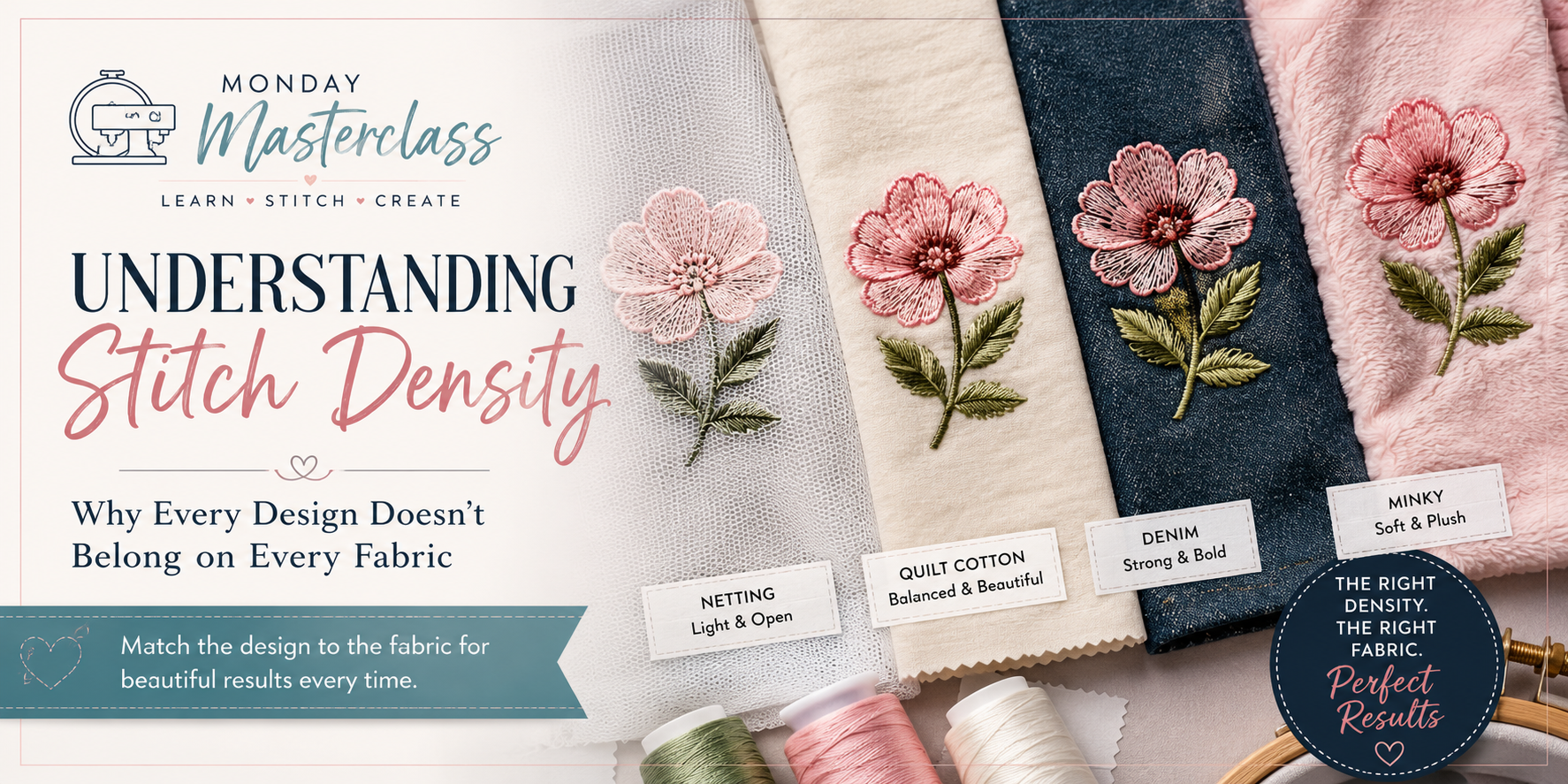
Understanding Stitch Density
Why Every Design Doesn't Belong on Every Fabric
One of the biggest misconceptions in machine embroidery is that a design is either "good" or "bad." In reality, most embroidery problems have very little to do with the design itself. More often than not, the design simply wasn't matched to the right fabric.
Think of it this way—you wouldn't wear hiking boots to a ballroom dance, and you wouldn't wear high heels to climb a mountain. Both shoes are perfectly made for their purpose, but neither is suited to the wrong environment.
Embroidery designs work exactly the same way.
A beautifully digitized design can produce disappointing results if it's stitched onto a fabric that simply can't support the amount of thread being added. That's where understanding stitch density becomes one of the most valuable skills an embroiderer can learn.
Difficulty: ⭐⭐☆☆☆ Beginner to Intermediate
You'll Learn:
- ✔ What stitch density really means
- ✔ Why fabric matters just as much as the design
- ✔ How to choose the right density for different fabrics
- ✔ When stabilizer helps—and when it doesn't
- ✔ Professional tips for stitching on netting, faux leather, vinyl, denim and minky
- ✔ How to troubleshoot density-related embroidery problems
What Exactly Is Stitch Density?
Stitch density refers to how closely embroidery stitches are packed together within a design. Imagine filling a one-inch square with thread. The more stitches squeezed into that space, the denser the embroidery becomes.
A common misconception is that more stitches automatically create better embroidery. In reality, the opposite is often true. Good digitizing isn't about using as many stitches as possible—it's about using only the stitches that are needed.
A useful comparison is painting a wall.
One coat of paint might not provide enough coverage. Two coats usually look perfect. Ten coats would leave the surface thick, uneven, and prone to cracking.
Embroidery behaves in much the same way. Too few stitches leave gaps, while too many stitches create unnecessary weight and stress on the fabric.
The goal is always balance.

The Fabric Makes the Decision
One lesson every embroiderer eventually learns is that the fabric decides how much stitch density it can carry.
Many beginners assume the design determines everything, but experienced embroiderers know that fabric plays an equally important role. Every stitch pushes a needle through the material, and every needle penetration changes that fabric just a little.
Some fabrics welcome thousands of stitches. Others begin struggling long before the design is finished.
Learning to recognise those differences will solve many of the most common embroidery problems before they even happen.
Delicate Fabrics Need Room to Breathe
Lightweight fabrics such as bridal tulle, organza, mesh, lace and decorative netting have very little structure of their own. Their beauty comes from their transparency and softness, which also makes them some of the most challenging fabrics to embroider.
When a heavy, densely stitched design is placed onto these fabrics, the embroidery often overwhelms the material. Instead of lying flat, the fabric begins to pull inward, wrinkle, distort or collapse under the weight of the thread.
For these fabrics, lighter designs almost always produce more elegant results. Open satin stitches, airy fills and lace-inspired digitizing allow the fabric to remain visible while still creating beautiful embroidery.
Sometimes, less really is more.

"Can't I Just Add More Stabilizer?"
This is probably one of the most frequently asked questions in embroidery.
The short answer is... yes, but only to a point.
Adding several layers of water-soluble stabilizer can make an extremely delicate fabric much easier to embroider. The stabilizer supports the fabric while the machine is stitching and helps prevent the design from shifting or sinking into open mesh.
However, once that stabilizer is washed away, the fabric is left carrying the full weight of the embroidery on its own.
This is why stabilizer should never be thought of as a magic solution.
Think of stabilizer as scaffolding around a building. It provides support during construction, but once it's removed, the building still has to stand on its own foundation.
If a design is simply too heavy for netting or tulle, no amount of temporary stabilizer will permanently change that fact.
In these situations, creating the embroidery as a freestanding patch or appliqué and attaching it afterwards often produces a far more attractive and durable result.
Sometimes changing the application is smarter than fighting the fabric.
Leather and Vinyl Tell a Different Story
Faux leather, genuine leather and plastic vinyl introduce an entirely different challenge.
Unlike fabric, these materials don't stretch very much.
Instead, they perforate.
Every stitch leaves a permanent hole, rather like a sewing machine creating the perforated line on a sheet of postage stamps. Add enough holes close together, and eventually the material becomes weakened.
This is why very dense designs or excessive overlapping stitches can actually cause leather to tear around the embroidery.
Rather than increasing stitch density, leather generally responds much better to cleaner digitizing with fewer overlaps and well-planned stitch paths.
In embroidery, more stitches don't always create a stronger design. Sometimes they create the exact opposite.
One Suggestion I can make here, is to add a layer of water soluble vilene over your faux leather, vinyl before stitching, this ensures the stitches don't get pulled in and sometimes looking like they disappear in the leather.

Cotton Is the Comfortable Middle Ground
Quilting cotton is one of the most forgiving fabrics you'll ever embroider.
It has enough stability to support medium-density designs while still remaining soft enough for everyday projects. Florals, quilting motifs, decorative borders, appliqué and lettering all perform beautifully on quality quilting cotton when paired with the correct stabilizer.
This is one of the reasons quilting cotton is so often recommended for beginners. It allows you to focus on learning your machine without constantly fighting the fabric.
Lightweight cottons and dress fabrics require a little more care because they move more easily, but with appropriate stabilization they still handle medium-density designs very well.

Heavy Fabrics Can Carry More Weight
Denim, canvas and similar heavyweight fabrics naturally support larger, more densely stitched embroidery.
These fabrics have enough strength to distribute the weight of thousands of stitches without distorting as easily as lighter materials.
That doesn't mean every design should be made denser—it simply means these fabrics are more forgiving when stitching bold logos, western embroidery or heavily filled decorative designs.
The fabric is doing much more of the work for you.

Fluffy Fabrics Present a Different Challenge
Minky, fleece and terry towels aren't usually limited by strength.
Instead, they're limited by height.
The soft pile tends to swallow embroidery, causing stitches to disappear beneath the surface. This often leads embroiderers to believe the design wasn't dense enough.
In reality, the solution isn't always to dramatically increase the stitch count.
Using water-soluble topping allows the stitches to sit above the fibres instead of sinking into them. Combined with suitable underlay and carefully balanced density, the embroidery remains crisp without becoming unnecessarily heavy.
Sometimes the answer isn't more stitches.
It's helping the stitches stay visible.

Learning to Read the Warning Signs
Your embroidery machine will often tell you when a design and fabric aren't getting along.
If you notice excessive puckering, repeated thread breaks, stiff embroidery, visible pulling around the design, or leather beginning to weaken around stitch lines, the fabric is usually telling you it has reached its limit.
These are not always signs of poor digitizing.
More often, they're signs that the fabric is being asked to support more embroidery than it comfortably can.
Choosing the Right Match
As a general guideline, lighter fabrics benefit from lighter embroidery, while stronger fabrics comfortably support more detailed and heavily stitched designs.
| Fabric | Typical Density |
|---|---|
| Tulle, Netting, Organza | Very Light |
| Lace | Light |
| Lightweight Cotton | Light to Medium |
| Quilting Cotton | Medium |
| Linen | Medium |
| Stretch Knits | Medium (with cut-away stabilizer) |
| Denim | Medium to High |
| Canvas | Medium to High |
| Faux Leather | Medium (avoid heavy overlap) |
| Vinyl | Medium |
| Terry Towels | Medium to High with water-soluble topping |
| Minky & Plush Fabrics | Medium to High with topping |
Three Rules Every Embroiderer Should Remember
Rule #1
The fabric decides how much stitch density it can support—not the design.
Rule #2
Stabilizer helps during stitching, but it cannot permanently compensate for a design that is too heavy for the chosen fabric.
Rule #3
When you really want to embroider a dense design on a delicate material, don't be afraid to change the application. A beautifully stitched patch or appliqué can often achieve a better result than forcing the embroidery directly onto the fabric.
Final Thoughts
One of the greatest skills an embroiderer can develop isn't learning how to stitch denser—it is learning when not to.
Every successful embroidery project is a partnership between the design, the fabric, the stabilizer and the thread. When those four elements work together, the results look effortless.
Remember, the best embroidery isn't the design with the most stitches. It's the design where every stitch has a purpose.


7 comments
Marijean Gissel
Excellent info for any embroiderer whether just beginning or with lots of experience.
Christine Kohli
Very useful information debunking common mistakes.
Erin Parr
Excellent content, especially for a new Embroidery person. Thank you
katherine
I have made several of your quilts and designs and never had an issue with the stitches. Always a joy to do…great article and right on the money.. thank you
Dianne
I’ve learned a lot from this Masterclass , will save to my bookmarks for future reference!
Dianne
I’ve learned a lot from this Masterclass , will save to my bookmarks for future reference!
Teresa
This Masterclass is just like the rest of the classes: easy to understand, well organized and extremely helpful. Thank you so much for sharing your knowledge and expertise.