
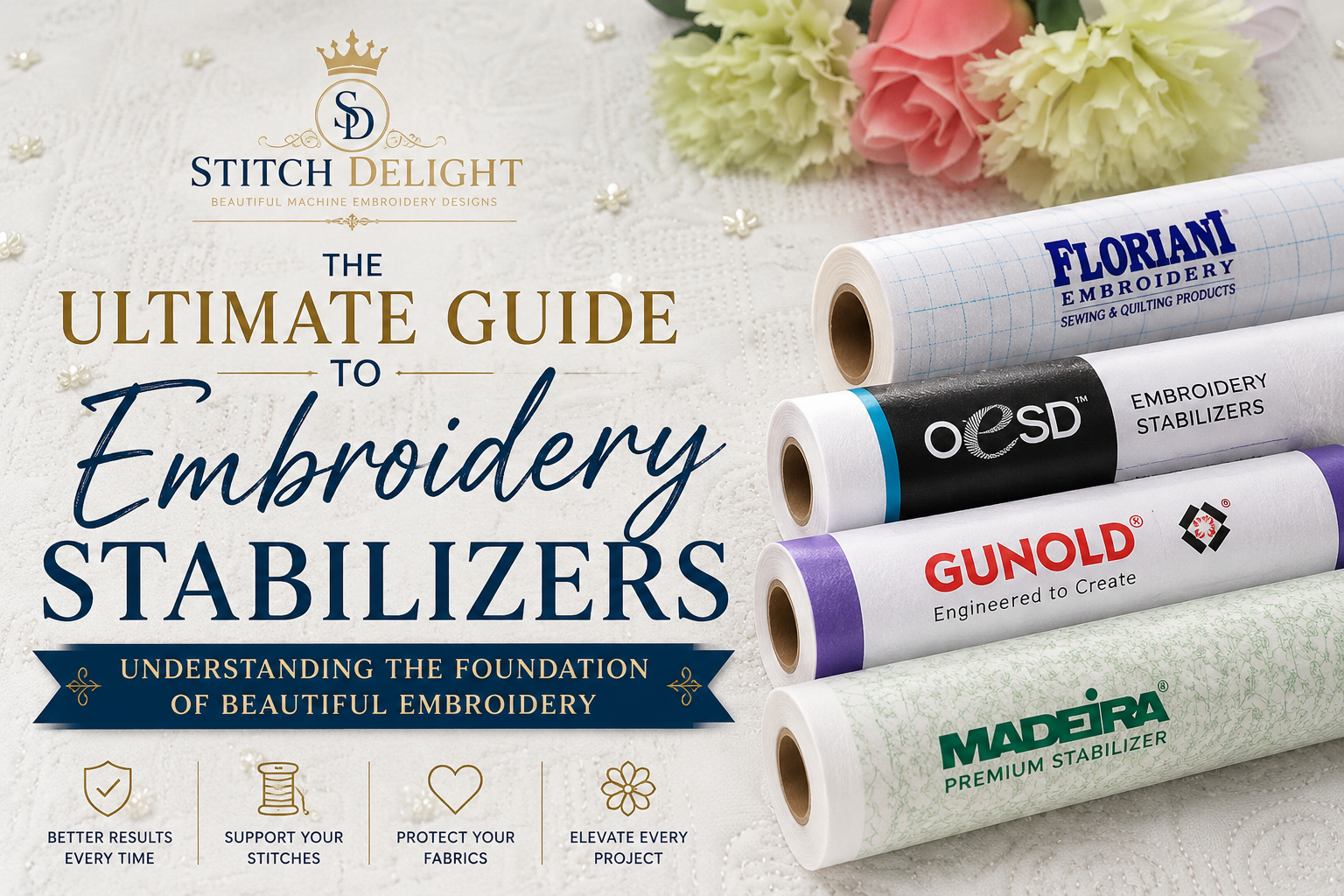
The Ultimate Guide to Embroidery Stabilizers
Understanding the Foundation of Beautiful Embroidery
When an embroidery design stitches beautifully, most people admire the thread, the design, or the machine that created it. What they rarely see is the unsung hero working behind the scenes—the stabilizer.
In reality, stabilizers are one of the most important components of successful embroidery. A perfectly digitized design can fail spectacularly when paired with the wrong stabilizer, while an average design can often be transformed simply by choosing the correct backing.
Whether you are a beginner trying to understand the difference between cut-away and tear-away, or an experienced embroiderer looking to improve your results, understanding stabilizers will dramatically improve the quality of your embroidery.
Let's explore the fascinating world of stabilizers and learn how to choose the right foundation for every project.
What Is a Stabilizer?
A stabilizer is a support material placed underneath, on top of, or occasionally both above and below fabric during embroidery.
Its primary purpose is to prevent the fabric from moving, stretching, shifting, or distorting while thousands of stitches are being placed into it.

Every embroidery stitch creates tension. Without proper support, the fabric can become distorted, causing:
-
Puckering
-
Misaligned stitching
-
Poor registration
-
Distorted lettering
-
Designs pulling out of shape
-
Excessive thread breaks
-
Poor wash durability
Simply put, stabilizers help the fabric resist the forces created during embroidery.
Think of a stabilizer as the foundation of a house. No matter how beautiful the house may be, it will eventually fail if the foundation is weak.
The Main Categories of Stabilizers
Although stabilizers are available in many forms, most fall into five primary categories:

-
Cut-Away Stabilizers
-
Tear-Away Stabilizers
-
Wash-Away Stabilizers
-
Heat-Away Stabilizers
-
Self-Adhesive (Sticky Back) Stabilizers
Each type serves a specific purpose and understanding their differences is the key to embroidery success.
Cut-Away Stabilizers
Cut-away stabilizers are considered the gold standard for garment embroidery.
As the name suggests, excess stabilizer is cut away after embroidery, while the portion directly behind the design remains permanently attached to the garment.
This permanent support continues protecting the embroidery long after it leaves the hoop.
Best Used For
-
T-shirts
-
Polo shirts
-
Sweatshirts
-
Stretch fabrics
-
Performance wear
-
Baby clothing
-
Knit fabrics
Why Cut-Away Works So Well
Knitted fabrics naturally stretch. If all support is removed after embroidery, the fabric can continue stretching and distort the design over time.
Cut-away stabilizers remain behind the embroidery, helping maintain the shape of both the fabric and the stitched design.
Types of Cut-Away Stabilizers
Lightweight Cut-Away
Typically around 1.5 oz.
Suitable for:
-
Lightweight knits
-
Baby garments
-
Fine T-shirts
-
Delicate apparel
Medium Weight Cut-Away
Usually 2.0–2.5 oz.
This is the most versatile cut-away and often considered the "everyday" stabilizer.
Suitable for:
-
Standard T-shirts
-
Polo shirts
-
General garment embroidery
Heavy Weight Cut-Away
Typically 3 oz or greater.
Suitable for:
-
Dense designs
-
Heavy garments
-
Jackets
-
Commercial embroidery
No-Show Mesh
Many professional embroiderers consider no-show mesh one of the most useful stabilizers available.
It appears similar to a soft netting rather than traditional backing and provides excellent support without adding bulk.
Benefits include:
-
Soft feel against the skin
-
Minimal show-through
-
Excellent stability
-
Reduced garment stiffness
No-show mesh is especially popular for:
-
Golf shirts
-
Performance fabrics
-
Lightweight garments
-
Ladies' apparel
Fusible Cut-Away
Fusible cut-away contains a heat-activated adhesive.
The stabilizer is lightly ironed onto the fabric before hooping, creating a temporary bond that minimizes shifting during embroidery.
Ideal for:
-
Stretch fabrics
-
Slippery materials
-
Delicate garments
-
Difficult-to-hoop fabrics
Tear-Away Stabilizers
Tear-away stabilizers are designed to be removed after embroidery by tearing away excess material.
Because they do not remain behind the design, they are best suited to stable woven fabrics.
Best Used For
-
Quilting cotton
-
Linen
-
Canvas
-
Aprons
-
Home décor projects
-
Stable woven fabrics
Types of Tear-Away Stabilizers
Lightweight Tear-Away
Suitable for:
-
Quilt blocks
-
Lightweight cottons
-
Small embroidery designs
Medium Weight Tear-Away
A versatile general-purpose stabilizer.
Suitable for:
-
Home décor
-
Linen
-
Cotton fabrics
-
Aprons
Heavy Weight Tear-Away
Suitable for:
-
Larger designs
-
Dense stitch counts
-
Structured fabrics
Fusible Tear-Away
Fusible tear-away combines temporary adhesive support with easy removal.
The stabilizer is ironed onto the fabric before embroidery and torn away afterward.
Many embroiderers find this particularly useful for linen, which can shift easily during stitching.
A Common Tear-Away Mistake
One of the most common stabilizer mistakes is using tear-away on stretchy knit fabrics.
Although the embroidery may initially appear successful, removing the stabilizer leaves the fabric unsupported. Over time, stretching and washing can distort the design.
For knit fabrics, cut-away is almost always the better choice.
Wash-Away Stabilizers
Wash-away stabilizers dissolve completely when exposed to water.
These stabilizers are invaluable when no backing should remain visible after embroidery.
Types of Wash-Away Stabilizers
Film-Type Wash-Away
Often referred to as topping.
This transparent film is placed on top of textured fabrics before embroidery.
Its purpose is to prevent stitches from sinking into the surface.
Common applications include:
-
Towels
-
Fleece
-
Sherpa
-
Velvet
-
Minky
-
Plush fabrics
Fabric-Type Wash-Away
Looks and feels similar to fabric.
Used beneath embroidery when complete removal is desired.
Ideal for:
-
Cutwork
-
Heirloom embroidery
-
Delicate fabrics
Mesh Wash-Away
Offers excellent strength while remaining lightweight.
Commonly used for:
-
Organza
-
Sheer fabrics
-
Delicate lace projects
-
Fine embroidery
Heavy Wash-Away
Provides maximum support.
Often used for:
-
Freestanding lace
-
Lace ornaments
-
Lace bowls
-
Stand-alone lace projects
Heat-Away Stabilizers
Heat-away stabilizers disappear when exposed to high temperatures.
These products are useful when moisture could damage the project.
Applications include:
-
Velvet
-
Specialty textiles
-
Certain decorative projects
Although less common in home embroidery, they can be invaluable for specific applications.
Sticky Back Stabilizers
Sticky back stabilizers feature an adhesive surface covered by release paper.
The stabilizer is hooped first, then scored and peeled to expose the adhesive surface.
The fabric is placed directly onto the stabilizer rather than being hooped itself.
This technique is especially helpful for difficult-to-hoop items.
Best Uses for Sticky Back Stabilizers
-
Caps
-
Cuffs
-
Collars
-
Pockets
-
Small garments
-
Delicate fabrics
-
Pre-constructed items
Sticky-back versions are available in cut-away, tear-away, and wash-away varieties.
Understanding Toppings
Toppings are often overlooked but can dramatically improve embroidery quality.
Unlike traditional stabilizers, toppings are placed on top of the fabric.
Their purpose is not to stabilize the fabric but to stabilize the stitches.
By creating a smooth surface, toppings prevent stitches from disappearing into textured fabrics.
When Should You Use a Topping?
Always consider a topping when embroidering:
-
Towels
-
Fleece
-
Sherpa
-
Minky
-
Plush fabrics
-
Corduroy
The difference between using a topping and not using one is often dramatic.
Matching Stabilizers to Fabric Types
Choosing the correct stabilizer begins with understanding your fabric.
T-Shirts
Recommended:
-
Medium-weight cut-away
-
No-show mesh
Polo Shirts
Recommended:
-
No-show mesh
-
Medium cut-away
Sweatshirts
Recommended:
-
Medium to heavy cut-away
Towels
Recommended:
-
Tear-away or cut-away underneath
-
Water-soluble topping on top
Quilting Cotton
Recommended:
-
Tear-away
Linen
Recommended:
-
Fusible tear-away
-
Medium tear-away
Organza
Recommended:
-
Wash-away mesh
Freestanding Lace
Recommended:
-
Heavy wash-away
Caps
Recommended:
-
Heavy tear-away
-
Sticky-back tear-away
Performance Fabrics
Recommended:
-
No-show mesh
-
Fusible cut-away
Do Stabilizers Affect Needle Choice?
Indirectly, yes.
While stabilizers do not usually require special needles, the fabric-stabilizer combination often influences needle selection.
65/9 Needle
Best for:
-
Organza
-
Sheer fabrics
-
Fine materials
75/11 Needle
Best for:
-
General garment embroidery
-
Most apparel projects
80/12 Needle
Best for:
-
Towels
-
Denim
-
Medium-weight fabrics
90/14 Needle
Best for:
-
Canvas
-
Jackets
-
Heavy fabrics
Ballpoint Needles
Recommended for:
-
Knits
-
Stretch fabrics
Sharp Needles
Recommended for:
-
Woven fabrics
-
Linen
-
Cotton
Solving Common Embroidery Problems with Stabilizers
Many embroidery issues can be corrected simply by changing the stabilizer.
Puckering
Often caused by:
-
Insufficient stabilization
-
Incorrect stabilizer choice
-
Poor hooping technique
Design Pulling In
Usually indicates inadequate support beneath the embroidery.
Registration Problems
Frequently caused by fabric movement during stitching.
Poor Small Lettering
Often the result of instability rather than digitizing issues.
Loopy Towel Embroidery
Almost always improved with a water-soluble topping.
Do You Need Expensive Brand-Name Stabilizers?
This is one of the most frequently asked questions in embroidery.
The answer may surprise you.
Not necessarily.
While some premium stabilizers offer excellent consistency and quality control, many stabilizers are produced by the same manufacturers and sold under different brand names.
What truly matters is:
-
Weight
-
Density
-
Fiber quality
-
Consistency
-
Performance
Rather than focusing solely on the label, learn to evaluate stabilizers based on their characteristics and suitability for the job. Buy small amounts of different ones and experiment with the knowledge you have now.
How Commercial Embroidery Shops Save Money
Most commercial embroidery businesses do not purchase small hobby-sized rolls.
Instead, they often purchase industrial-width master rolls.
Common widths include:
-
1 meter
-
1.2 meters
-
1.5 meters
These large rolls are significantly more economical.
Many embroiderers cut them into manageable widths for daily use.
Some use electric carving knives, cutting jigs, bandsaws, or even a sturdy bread knife to divide large rolls into hoop-friendly sizes.
The savings over time can be substantial, especially for businesses with high embroidery volumes.
My Five Essential Stabilizers
If I could keep only five stabilizers in my embroidery room, they would be:
-
Medium Weight Cut-Away
-
No-Show Mesh
-
Medium Weight Tear-Away
-
Water-Soluble Topping
-
Heavy Wash-Away
With these five products, I could successfully complete the vast majority of embroidery projects that come through a typical embroidery studio.
Lets sum this up so you can quickly find what stabilizer to use when :
STABILIZER QUICK REFERENCE GUIDE
| Project / Fabric | Recommended Stabilizer | Extra Notes |
|---|---|---|
| T-Shirts | Cut-Away or No-Show Mesh | Never use tear-away |
| Polo Shirts | No-Show Mesh | Soft against skin |
| Sweatshirts | Medium/Heavy Cut-Away | Supports dense designs |
| Stretch Fabrics | Cut-Away | Permanent support needed |
| Towels | Tear-Away + Water-Soluble Topping | Prevents stitches sinking |
| Fleece | Tear-Away + Topping | Improves stitch definition |
| Minky | Tear-Away + Topping | Essential for clean embroidery |
| Quilting Cotton | Tear-Away | Stable woven fabric |
| Linen | Fusible Tear-Away | Prevents shifting |
| Canvas | Tear-Away or Heavy Tear-Away | Stable fabric |
| Organza | Wash-Away Vilene | Leaves no backing |
| Freestanding Lace | Heavy Wash-Away Vilene | Complete support required |
| Cutwork | Wash-Away Vilene | Backing disappears |
| Caps | Heavy Tear-Away | Industry standard |
| Pockets | Sticky-Back | Easy hooping |
| Cuffs | Sticky-Back | Avoids hoop marks |
| Delicate Fabrics | Fusible Cut-Away | Reduces movement |
| Performance Wear | No-Show Mesh | Lightweight and soft |
WHAT PROBLEM ARE YOU TRYING TO SOLVE?
| Problem | Solution |
|---|---|
| Puckering | Stronger stabilizer |
| Small text looks poor | More stabilization |
| Design sinks into towel | Add topping |
| Knit garment stretches | Use cut-away |
| Fabric shifts in hoop | Use fusible or sticky-back |
| Freestanding lace collapses | Use heavier wash-away |
| Embroidery feels stiff | Use no-show mesh |
| Backing visible through garment | Use white no-show mesh |
Final Thoughts
Embroidery machines, thread, needles, and digitizing all play important roles in producing beautiful embroidery.
However, the stabilizer remains the foundation that supports everything else.
When embroidery goes wrong, we often blame the machine, the thread, or the design. Yet the real problem is frequently hidden beneath the hoop.
Learning to choose the correct stabilizer for each project is one of the fastest ways to improve your embroidery quality, reduce frustration, and achieve professional results.
Because while the stitches may receive the compliments, it is the stabilizer that quietly does the hard work behind the scenes.
Here is a quick cheat sheet to sum up what we learned today.
Download your FREE Cheat Sheet HERE
Or scan the code to download.


3 comments
Ute Tomasi
Vielen Dank für das schöne Geschenck
Ute Tomasi
Tausend Danke für dieses schöne Geschenck
Janette
Thanks a million. This is great? Appreciate.